
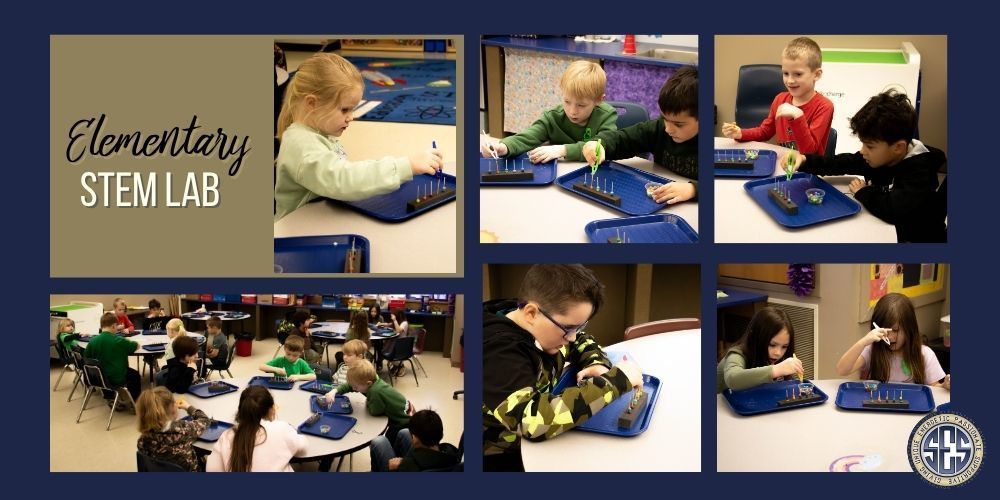
In our STEM Lab, small hands took on a colorful challenge - and the skills they practiced reach far beyond the classroom table.
The setup is straightforward: a foam block, five toothpicks, a cup of colorful beads, and a pair of tweezers. But in STEM Lab, facilitator Ms. Marsha Candler, challenges students from kindergarten through third grade in more ways than one.
Ms. Marsha called out instructions one at a time - the color of the bead to retrieve and the numbered position (1–5) where it should be placed The students listened, located the right bead, gripped it with tweezers, and carefully threaded it onto the correct pin. Simple? In theory. Challenging? Absolutely.
"Fine motor skills are the quiet foundation beneath reading, writing, and so much of what we ask children to do every single day."
Fine motor skills involve the coordinated use of the small muscles in the hands and fingers - the kind of precision needed to hold a pencil, button a coat, or use scissors. Unlike gross motor skills (running, jumping, climbing), fine motor development requires patience, focus, and repeated practice. And the earlier children build these skills, the better prepared they are for the demands of school.
In Ms. Marsha's bead activity, students weren't just practicing grip. Every time a child reached for the correct bead color, they were exercising visual discrimination - the ability to distinguish between objects by appearance. Every time Ms. Marsha called out a position number, students had to translate a spoken word into a physical location. That's listening comprehension, number recognition, and spatial reasoning all at once.
The activity also reinforces ordinal language - first, second, third, fourth, fifth. When a student hears "place it in position three” or “on the third toothpick" they're mapping spoken language to a physical sequence. That understanding of order directly supports early reading, where children must grasp that letters and words follow a specific left-to-right direction. The toothpick board, numbered one through five, quietly trains that same directionality.
There's also something important happening socially. As the photos show, students work side by side, quietly absorbed in the same task. They observe each other's technique, self-correct, and stay focused in a shared space - all essential classroom behaviors that support learning in every subject area.
Fine motor development is one of those building blocks that, when strong, makes everything else easier. Children who struggle to control a pencil find writing exhausting and frustrating. Children who can't isolate individual fingers have difficulty with keyboards and manipulatives in math. The bead and toothpick activity is one small, joyful piece of a much larger puzzle - and in STEM Lab, every piece is placed with purpose.